B.Tech in Computer Science and Engineering
2023–2027Visvesvaraya Technological University (VTU), Belagavi, Karnataka, India
CGPA: 8.02/10
Researcher & Engineer · Computer Science
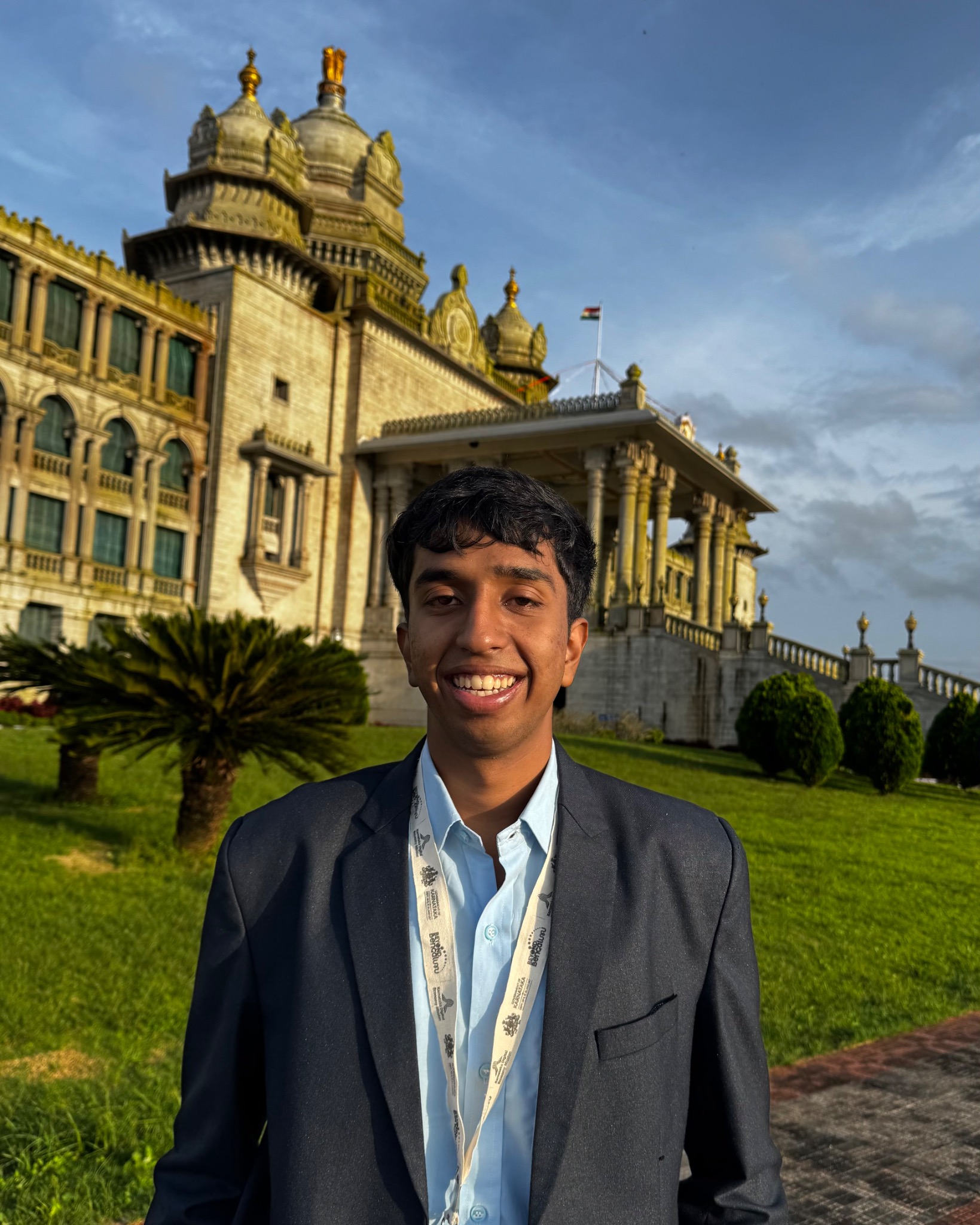
I study how intelligent systems work, where they fail, and what is lost when uncertainty is compressed into simplified representations. My research interests connect information theory, geometry, machine learning evaluation, and sequential decision-making. I am interested in understanding when information-preserving assumptions break down and how those failures change model decisions.
Epistemic uncertainty and calibration; information loss in sequential systems; representation geometry and robustness under distribution shift; evaluation metrics and capability detection; reinforcement learning and model behaviour.
Visvesvaraya Technological University (VTU), Belagavi, Karnataka, India
CGPA: 8.02/10
Studies conditions under which sequential detection can be represented by a scalar statistic without losing decision-relevant information.
Poster page · Sydney poster session: 10 December 2026, 10:00 AM–1:00 PM AEDT.
Studies how rollout latency and asynchronous data collection can introduce selection bias in reinforcement learning from human feedback.
Poster page · Sydney poster session: 8 December 2026, 5:00–8:00 PM AEDT.
Examines when scalar evaluation metrics fail to distinguish systems with meaningfully different behaviour.
A post-hoc diagnostic for assessing whether frozen representations preserve task-relevant information under anticipated distribution shifts.
Studies alignment between uncertainty estimates and model sensitivity to input changes in high-risk prediction settings.
Working with Dr. M. N. Birje on how model capabilities emerge during training and how detection timing depends on evaluation resolution. Studies the distinction between a capability first becoming detectable and becoming reliably usable across training checkpoints.
Presented “AI-Driven, Uncertainty-Aware Anomaly Detection in Multi-wavelength AstroSat Observations” at A Decade of AstroSat Observations: Science Outcomes and Future Prospects, organised by the U. R. Rao Satellite Centre (URSC), ISRO, Bengaluru, 30 January–1 February 2026.
Contributed to BIOLOOP, an AI-enabled algal biorefinery concept for industrial CO₂ capture and biomass production, and to S2N, a seawater-based green-hydrogen initiative. BIOLOOP was included in an AI-in-energy case study for the India AI Impact Summit 2026.
Presented “Real-Time Monitoring of Bioaerosol Emissions in Hydrogen Reactors” at the 14th Asian Aerosol Conference (AAC 2025), Mumbai, December 2025.
Global AI Impact Commons case study · Poster story · Casebook announcement
Research on latent microstructure regimes and early signals in high-frequency limit order book data. Paper · Repository
Tool for detecting look-ahead bias and accidental use of future data in time-series machine-learning pipelines. PyPI · Repository · Project note
A C++ and Gymnasium environment for exploring reinforcement-learning approaches to latency optimisation in trading infrastructure. Repository · Project note
Multivariate temporal correlation engine for anomaly detection across related infrastructure and financial metrics. PyPI · Repository
Time-travel debugging and transformation-lineage tracking for Pandas and Polars workflows. PyPI · Repository
A time-aware metric designed to evaluate when a detector identifies an event alongside detection quality. Paper · PyPI · Colab
Algae-based approach to industrial CO₂ capture and biomass production. Contributed before exiting the initiative.
Seawater-based green-hydrogen initiative exploring pathways for hydrogen production.
Google Scholar: scholar.google.com/citations?user=ERbZUdoAAAAJ
GitHub: github.com/prakulhiremath
LinkedIn: linkedin.com/in/prakulhiremath
OpenReview: openreview.net/profile
Medium: medium.com/@prakulhiremath